I Guess We Just Didn't Have a Read on the Meta
We're sharing the latest edition of The Counterbalance, the newsletter of the Balanced Economy Projection, a global antimonopoly initiative. This article was originally published here. Yous tin sign upwards for their newsletter here.
Frances Haugen, the historic Facebook whistleblower, briefly became a bit of a cult hero for exposing the behemothic platform's toxic role pushing algorithms that encourage teenage suicides, threaten national security, go easy on drug cartels and drug traffickers, foster riots, or destabilise democracies – and so lying about it and standing to push its intensely profitable and addictive ("similar cigarettes") product.
But her testimony contains a fatal flaw: she wants us to 'set' and regulate Meta, the company formerly known as Facebook. This is what the company wants, and indeed is actuallyrequest for, considering it distracts usa all from the only thing that volition really make a divergence:breaking its power.
Until we do that, the giant will lobby, sidestep and bulldozer its way effectually (or through) any rules, laws, taxes, regulations and "fixes" that nosotros throw at them.
Lawyers have known this for decades. Jack Blum, a prominent U.S. antitrust lawyer in the 1960s and 1970s, now in his 80s, remembers how companies would prefer to negotiate settlements with regulators, instead of having the law practical to them:
"That became a 'regulatory' approach," Blum told usa. "Regulation became the preferred approach of the industry people – because they knew they could push button the regulators to exercise what they wanted."
There are several means to break monopolists' power, includingof form with appropriate and effective regulation. But very often, especially with a ascendant giant, the simplest and well-nigh effective first step is to break information technology into smaller, less powerful pieces. Since the combined entity is stronger and more powerful than the sum of its parts, breakups can be very good ways to adjourn power. (For those skittish most breakups, read this.)
And that is exactly what the United kingdom's Competition and Markets Authority (CMA) is now doing, with a decision on November 30 that Meta must sell Giphy.
Giphy produces those irritating (or, if yous're more open-minded, hilarious) GIFs, or "graphics interchange format" moving images that pop upwards like distracting mushrooms through our increasingly electronic lives.
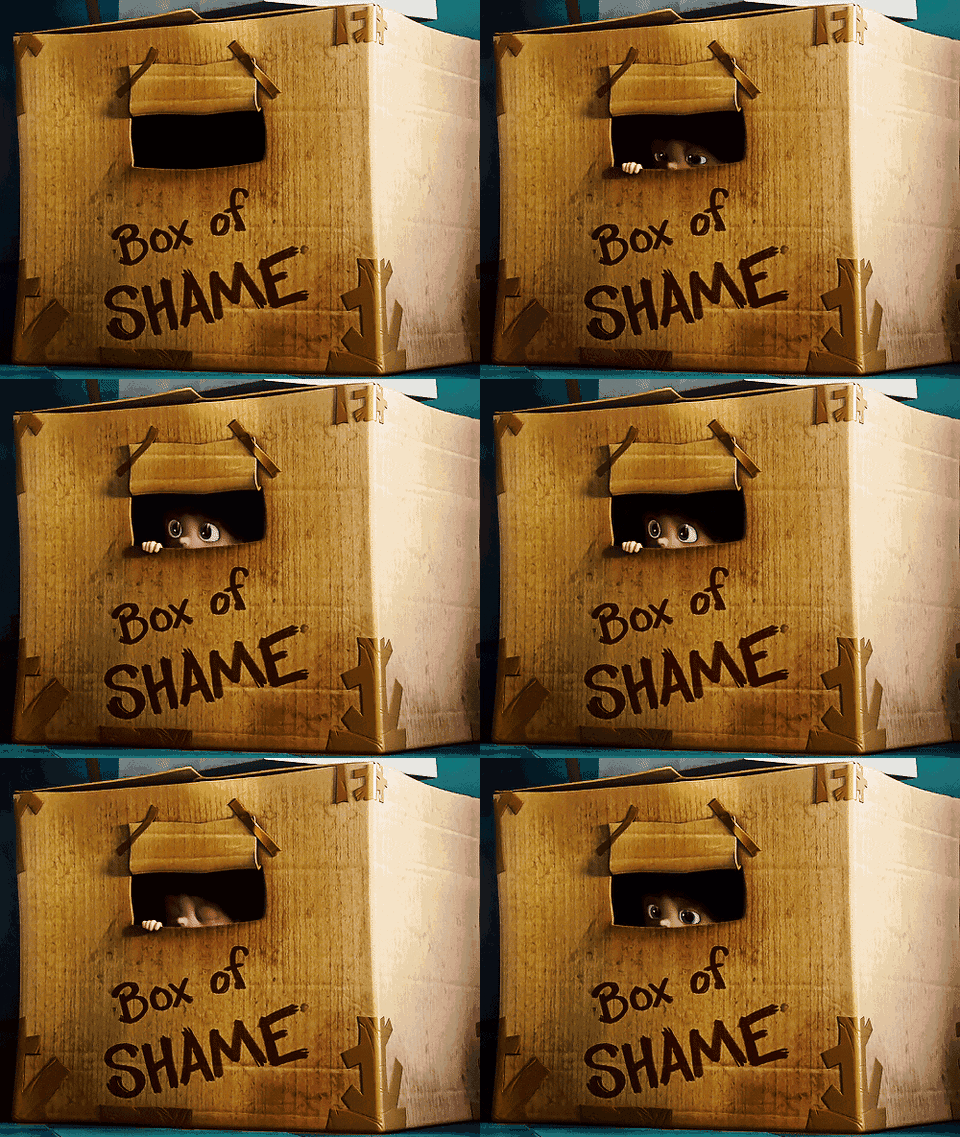
Having just acquired Giphy, Meta must now sell it "in its entirety" to an approved heir-apparent. Yep, this is simply snapping off a small fragment of the Meta-behemoth, but this counts as a breakdown.
As a reminder of how significant this is, the GAFAM (Google, Amazon, Facebook, Apple, Microsoft) take caused more one,000 firms in the past 20 years, and, as the Eu'southward former chief contest economist, Tommaso Valletti,toldThe Counterbalancelast year, "cipher of those transactions were blocked — and 97 per centum were not even assessed by anybody. These are extreme, ridiculous numbers."
That is a ratio of one,000 to nil,globally. (In the U.k. the ratio for 2008-2018 was 400 to zero.) Neither the Americans, the Europeans, the British, nor anyone else, had blockedanythingin this space. Ridiculous indeed.
Now Giphy raises this from zero to i. So yep, this is a large deal. Even so outside of technocratic circles and a few specialist journalists,virtually nobody noticed!
And the significance of this goes far beyond Large Tech. Expect at these two graphs:
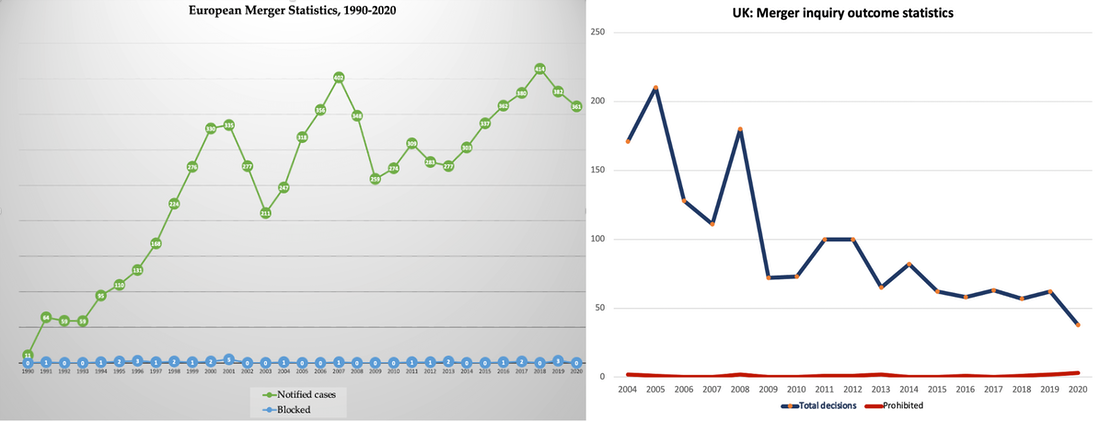
Source: European Commission; CMA; author's calculations. Of 8083 mergers notified to the EC since 1990, only 30, or 0.4 percent were blocked. The Great britain has blocked 17 out of 1,565, or 1.1 percent, since 2004.
They propose that our regulators, captive to a bad Chicago-School paradigm, don't block mergers, let alone pause them upwards. (Information technology was the same in the US for decades, until this year.) The last meaning forced breakup anywhere was of the telecoms firms AT&T – forced past U.s.a. regulators, in 1982-4.
In a nutshell, the whole corrupt Eu system substantially reflects the desires of monopolists.
All this may be a surprise to some given all the blessing (frequently fawning) media coverage of European union Contest boss Margrethe Vestager. Those Eu fines on big tech firms have been absorbed with barely a burp.
A Brussels insider described the Giphy case to us as "a bit of an earthquake," calculation "I was surprised how little buzz it got at [Europe'southward competition authorities.] I actually have a feeling that the antitrust establishment on both sides of the Atlantic is hoping to weather the neo-Brandeisian tempest with as little change to the prevailing Chicago schoolhouse paradigm as possible."
In the cloud, floating above the law
A striking attribute of the Facebook case is that the visitor didn't even bother waiting for the CMA'due south merger review earlier going alee with the deal, maybe hoping simply to bounce the CMA into accepting it by jumping the gun. (In the U.s., they seem to accept used financial chicanery to get effectually the rules on Giphy – and the EU, for its role, didn't review it.) Some companies seem to recollect they are to a higher place the law. Meta is far from lone: the U.s.a. business firm Illumina seems to accept been just as arrogant when it announced its acquisition of Grail, even before the EU had completed its review. In Australia recently, the top contest regulator Rod Sims, recently said that companies were sometimes "contemptuous" of the regulator.
*This paragraph has been updated** Thankfully, the CMA has shown some spine here. (China has taken a more than muscular approach also. The Usa Federal Trade Commission is also seeking a Meta breakup.)
The green shoots of Giphy
The Giphy instance raises big questions. For one affair, is the UK regulator within its rights, andtin it, strength a global breakup of a super-powerful US firm?
Yes: it is, and information technology can. The CMA already recently blocked a global merger of two US tech firms, Sabre and Farelogix. And with Meta, an altogether more formidable proposition, it has serious fill-in. Tim Cowen, a well known UK competition lawyer, explained that if the CMA sticks to its guns, it can get the chore done:
"Ultimately the CMA applies for a court society. That is issued and non compliance is contempt of court for which jail beckons – and brings the entire foreign judgements and enforcement organisation into play. That works for courtroom orders internationally and is the ground of the world trade system."
So, while Brexit has entailed many costs, information technology has in this case potentially freed the United kingdom of great britain and northern ireland to make a decisive interruption from Europe's pro-monopoly arroyo.
Still this is no slam-dunk, of class. The company has stunning lobbying power and influence: not to the lowest degree the fact that its key lobbyist, Nick Clegg, is a onetime deputy Prime Minister of the UK.
A bad-tempered struggle is at present underway: Facebook denounced the CMA in September, and the CMA in October fined the newly named Meta £50.5 meg for "consciously refusing" to provide information. Meta has already appealed the CMA determination and as Politico notes, it "volition spare no effort or billable hour to try to finish the breakup."
Will democracy prevail? We promise then. When the European Commission blocked the GE-Honeywell merger 20 years ago, they were faced with "the most intense politicking old hands there have seen. . . . .There were journalists, lobbyists and lots of arbitragers from Wall Street calling constantly." Then much and then, that as 1 (especially astute) observer put information technology:
"That conclusion set off a concerted campaign by the US to go the European union to prefer a more merger-friendly, 'economic' approach to merger review . . . . That campaign worked and its legacy is a runway tape of hardly any mergers blocked in the last two decades."
This Us government, at present showing impressive anti-monopoly chops, surely won't interfere in United kingdom of great britain and northern ireland politics similar that. But another might. And the CMA faces another major political headwind: a gaping hole where at that place should be support.
Civil society: a gap
While the Giphy case has got plenty of attention in narrow technocratic circles, in wider society it's barely registered. That's a stunning gap, given the importance of this case.
*the post-obit paragraph has been updated*
For example, when the CMA publicly requested comments on the case, almost no 18-carat independent civil lodge voices submitted comments. (An exception, which is non listed on the relevant CMA page, came from Privacy International, which fabricated an excellent and expert submission.one) The recollect tanks, which seem to have dominated commentary, that did seem to take unclear funding sources (are they funded by Meta?) and the two academics admitted openly that they have consulted for Facebook.
And if you delve into the submissions and other lobbying around the case, you'll see how other-worldly (and oftentimes nonsensical) the arguments are. For example:
- "Facebook . . . supplied reassurances to address the concerns raised past the CMA" (yeah, and we've a span to sell you);
- [this] is the blazon of over-enforcement that . . . depresses economic growth, and chills innovation" (Meta is an curvationmonopolist, for crying out loud: it is well known that monopoly reduces growth and kills innovation non to mention the damage it's inflicting on our democracy, on vaccination rates, and then on);
- "Giphy cannot be considered a competitor to Facebook" (where to first . . .)
- This will injure the UK's competitiveness. (Nonsense.)
- "The CMA is sending a chilling bulletin to start -up entrepreneurs: practice not build new companies because yous will not exist able to sell them." (See earlier comment on monopolists slaughtering innovation: Facebook has famously run a "copy – acquire – kill" strategy.)
And so on. To cutting a long story brusk, nosotros're in the odd state of affairs outside the Us where regulators are growing more activist than civil society. Thereare civil order actors making arguments here well-nigh power, such as Article xix, but they are rare. The civil social club dog isn't barking. This is dangerous, and nosotros're dedicated to changing this.
How and why to break upwards the giants
If regulators want to cake or unwind mergers, they face up an industry of economists, lawyers, courts, lobbyists, ordinarily a high brunt of proof and a pervasive pro-monopoly worldview. (The arguments become wonkish and circuitous, though in Giphy'due south case, the CMA fortunately side-stepped getting bogged downward in econometrics and deployed more sensible "theories of harm" (pp7-9) than some cases accept hinged on in the past.)
To start with, let's tackle some common misconceptions nigh breakups.
Offset, some people, mostly on the political left, dislike them (and competition policy more than mostly) considering they think that the principal purpose is to increment market competition, a process that they are suspicious of (for reasons good and bad, which we won't get into here.) Yet the prime purpose here is is to break Meta's power, so that information technology tin can be regulated – and yes, healthier competition reinstated – in the public interest.
2nd, many people retrieve that if you break a social media platform into pieces, so, well . . . how will I be able to lookout man that kitten fall hilariously into the yoghurt tub, if we're now on different parts of a broken-up platform?
I answer is the principle of inter-operabilitywhere regulators force platforms to suspension open their walled gardens and ensure that if you are on one platform, you'll be able to watch that kitten in yoghurt from another. (To illustrate, electronic mail or phone calls are interoperable: you lot can call or email anyone using any service.) And if i platform tries to forcefulness you to hand over republic-bending amounts of data, inter-operability lets yous drift to healthier one, without losing sight of the kitten. (The Eu's incoming Digital Services Act is likely to crave this, though it often falls woefully short.)
Third, when some people think of breakups they call back of Mickey Mouse in the filmFantasia, where a magic broom runs amok and so he cuts information technology upwards with an axe – merely to face a plethora of smaller magic brooms, and a situation even more out of control.
Constructive breakups don't work like that. Instead, yous separate companies as you might cut a diamond: along natural fracture lines (which could be, for instance, based on previous acquisitions; or along management reporting lines, etc.)
The conquering of Giphy had taken a familiar and thus of import fragment of the cyberspace and inserted it into a walled garden where information technology became juiced upward with massive market power. Since the combined entity became more than powerful than the sum of its parts, a well-judged breakup curbs power overall.
As the CMA put information technology, with Giphy:
people are less able to control how their personal data is used and may
finer exist faced with a 'accept it or leave it' offer when it comes to signing upwards to a platform's terms and conditions."
That'south raw power. According to the CMA, the Meta platforms (Facebook, Instagram etc.) business relationship for nearly iii quarters of social media use in the Britain, and half of all brandish advertising revenues (pp9-10). Meta can utilize this power to forcefulness united states of america into a devil's bargain to sign away our data – potentially with the kinds of consequences that Frances Haugen reminded united states of america of. For example, it and Google accept been effectively massacring local journalism at a global scale. If news organisations instead had a wide range of platforms to negotiate with, the scales could tip dramatically, potentially injecting billions into these crucial pillars of our democracy.
People make various other arguments confronting breakups. Many simply tin't exist bothered with the kerfuffle, or they think that it would be similar unscrambling eggs, or "inefficient," or that it "punishes success", or, perhaps most commonly, "this is nearly a bunch of free stuff, and we don't care."
Well, it's non free. The United kingdom estimates that digital advertising costs each household £500 a year through more expensive appurtenances and services, which is like a £14 billion tax effectively monopolised by Facebook and Google. (See this, or this.) And equally for punishing success, Facebook is earning an estimated 50% return on capital letter (p8) largely not for making better stuff, simply because information technology kills or eats its competitors.
A alarm from history
Mark Zuckerberg wants to bind us into a individual "metaverse" of virtual reality, conspiracy theories, puppies in yoghurt, teenage suicides, comedy skits, viral memes, thrilling immersive infinite voyages, and political violence dorsum on earth. He may feel that, every bit dictator of the Zuckerverse, he is chivalrous. Nosotros, and we promise you, disagree.
"The freedom of a democracy is not prophylactic if the people tolerate the growth of private ability to a signal where it becomes stronger than their autonomous country itself," U.S. President Franklin D. Roosevelt famously declared in 1938. "That, in its essence, is fascism — ownership of government by an private, past a group, or by any other controlling private ability."
As he spoke, something forth those lines was massing in Federal republic of germany, whose economic structure was intensely monopolised then. Certain, there were plenty of other reasons why Hitler came to power — and the world is entirely unlike today. Just make no mistake: dispersed and balancedeconomic ecosystems back uppolitical pluralism and balance, and on the flip side, monopolisation will probable entrench any autocrat's power and give them powerful economical levers to increase political potency. But expect at what Viktor Orban is doing in Hungary right now, or the symbiotic relationship between monopolising oligarchs and the regime of Belarus' dictator, Alexander Lukashenko. Wait in any country, in fact, where oligarchs accept carved upwardly the economy.
The dangers are especially acute when information technology comes to flows of data — which is what Meta and Big Tech are all near. That iii quarters of U.k. user time spent on social media probably underestimates the problem, every bit anyone who has kids with smartphones knows: social media's dazzling allure violently drags attention abroad from piano lessons and myriad healthy other things, and glues it into social media.

A fully fledged and successful metaverse will make this even worse. We take allowed Mark Zuckerberg, an unelected person manifestly drunkard with ability, finer to set the rules for how billions of people communicate with each other.
And this is, very apparently, very dangerous. As the US anti-monopolist Matt Stoller put it:
A regulatory overlay in some ways would worsen the trouble, because it would explicitly fuse political control with market place power over speech and it would legitimize the dominant monopoly position of Facebook."
The right is suspicious of such a regulator considering they are afraid of what Biden and the left would practice with information technology. Merely I suspect that suspicion isn't out of identify on the left either. If you lot are a Democrat, imagine, for instance, if Trump were able to pick a regulator for social media, to negotiate with Zuckerberg on how to run global soapbox.
Amend non to take such concentrated power in the kickoff identify."
Finally: update on a Us lawsuit to break upwards Meta, including Whatsapp and Instagram. This, if it succeeds, could be all the same more significant. More on this, some other time.
lemmonsoplamaidn1956.blogspot.com
Source: https://taxjustice.net/2022/01/18/the-uk-is-breaking-up-facebook-meta-and-almost-nobody-noticed/
0 Response to "I Guess We Just Didn't Have a Read on the Meta"
Post a Comment